Upper levels of caissons may be cast
while completed lower levels are submerged in sea water,
with the sea water curing the concrete of the lower levels.
This is useful if land infrastructure is not available
for constructing entire caissons on land.
For example, if a semi-submersible barge
is not available to transport completed caissons,
partially completed caissons can be sumberged
on the sea bed for completion of
upper levels of the caisson above the water.
When doing this, the sea water must be deep enough to
allow flotation after constructing the
caisson level that is above the water. This process
is repeated at different water depths as additional
caisson levels are constructed.
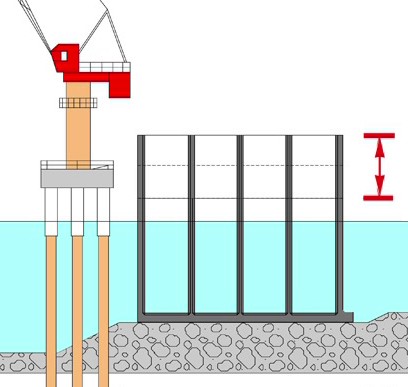
Figure 1:
Seabed for partially submerging caissons
during caisson construction, Kashima, Japan.
A crane is installed on posts to facilitate
caisson construction.
A partially constructed caisson is floated to the
seabed that is 9 meters deep.
[MLIT]
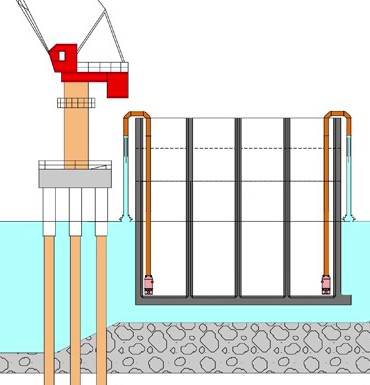
Figure 2:
Water pumps hanging in the sea have pumped sea water
into the caisson, causing the caisson to sink to the seabed.
The caisson is taller than the seabed is deep.
The upper portion of the caisson is above the
sea water surface.
[MLIT]
Figure 3:
Construction of the caisson has proceeded.
Two new levels have been added to the top of the caisson.
[MLIT]
Figure 4:
Water is pumped out of the caisson,
causing it to float.
[MLIT]
Figure 5:
The caisson is floated to the deeper seabed.
[MLIT]
Figure 6:
Water is pumped into the caisson to make it sink.
The bottom of the caisson rests on the seabed.
The top of the caisson is above the water surface,
where additional levels of the caisson will be constructed.
[MLIT]
Figure 7:
Two caissons under construction.
The caisson on the right is resting on seabed that is 9 meters deep.
The caisson on left is in 12 m deep water.
[MLIT]
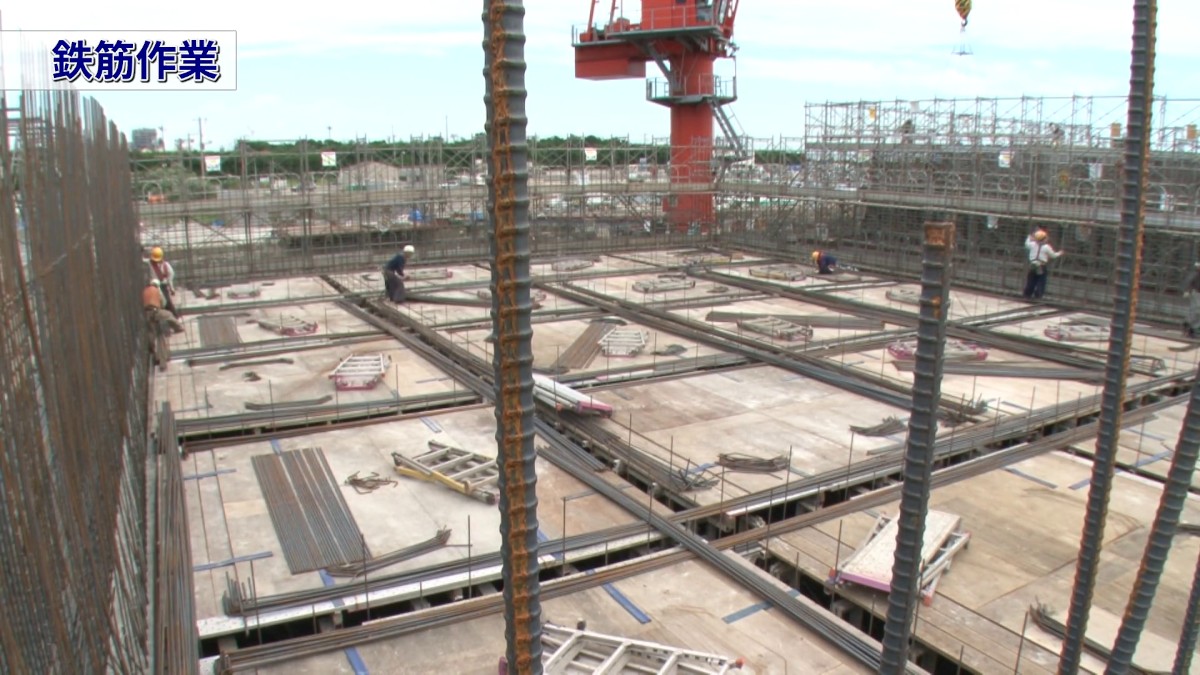
Figure 8:
Tying rebar (reinforcing bars) on the new level
of a caisson.
At right is
another caisson under construction.
[MLIT]
Figure 9:
Rebar is tied.
Forms are placed.
Work flooring is moved to top of forms.
[MLIT]