Caisson Seawalls
Quay Construction
Modern quay walls are constructed of large adjoining hollow concrete boxes that are filled with sand or other fill. Each of the large boxes is called a caisson, which is the French word for “large box” (similar to the Italian word cassone that has the same meaning).
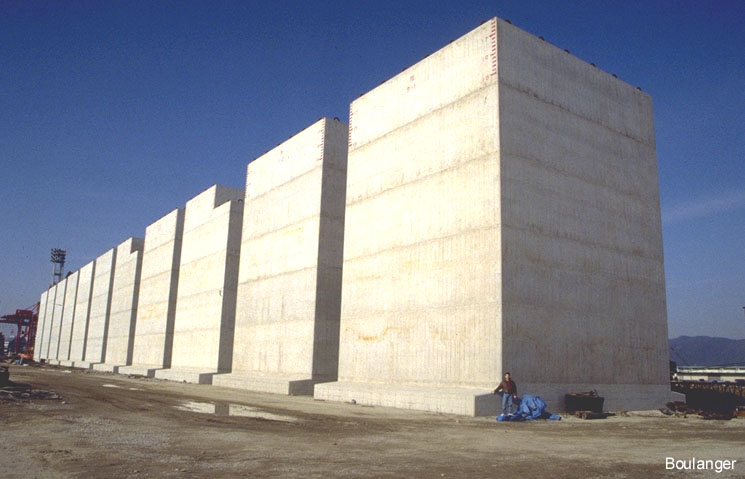
Each caisson (large box) is very big: the size of a multi-story building. For increased strength, the inside of a caisson is partitioned into multiple vertical boxes. A typical caisson has interior walls (all full height), with only one floor (at the bottom of the caisson).

One way of constructing and installing the caissons, as shown here in 1996 in Kobe Japan, is to construct the concrete caissons on land and then lift each caisson into the sea with a large offshore barge crane.

The caissons rest on the seabed attached to each other, with their own weight holding them down. They are filled in with sand or other fill, and capped with concrete.

Lessons have been learned from past caisson failures to provide guidance on new quay wall construction. It is important to prepare the seabed that caissons will rest on, and do a good job filling the new retained land.
The seabed under each caisson must be of suitable material to hold the weight of the caisson without shifting that would cause the caisson to tilt.
This usually involves removing (trenching) the seabed where caissons will rest, and replacing the removed seabed with material that is better suited for holding up a caisson. Compaction may also be used. Wick drains (called prefabricated vertical drains or PVDs) may be used during compaction of soft soils, to substantially shorten the required compaction time.
New retained fill must not be likely to experience shifting (liquefaction) after construction. Precautions may involve removing and replacing seabed that is not strong enough to hold new fill, and carefully placing new fill gradually instead of in a hurry, to allow for proper distribution and settling.
Caisson Seawalls
Page 2 :
Page 3 :
Page 4 :
Page 5 :
Page 6 :
Page 7 :
Page 8 :
Page 9 :
Page 10 :
Page 11 :
Quays
Quay Construct (this page)
Singapore
Tema, Ghana
Le Portier, Monaco
Colombo, Sri Lanka
Hitachinaka, Japan
Slip Form
Seawater Construct
Breakwater
Return to: AEC | Caisson Seawalls