Solar Thermal Electricity (STE)
California
Kramer Junction
The Solar Energy Generating System (SEGS) in Kramer Junction, California was an experimental parabolic trough collector (PTC) system that generated 354 MW of electricity from the 1980s until 2021. It was the first commercial PTC system, before molten salt storage was invented.
Before SEGS, it was not known whether PTC systems would be commercially successful, causing SEGS to seek funding for experimental technologies. In order to qualify for “experimental” funding, restrictions were placed on the project, in order to prevent the technology from competing with established power plants. The project turned out to be commercially successful, despite the restrictions.
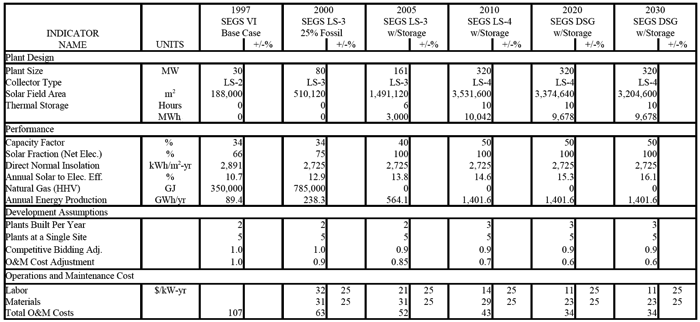
One of the restrictions was to reduce the sizes of the electricity generating steam turbines, for example from 80 MW to 30 MW.
Another restriction was to not allow the project to generate electricity with natural gas, despite using the same turbines that natural gas plants were using at the time. This meant the plant could not sell electricity at night, because night time storage had not yet been invented.
Since then, natural gas plants have switched to using higher temperature turbines, called combined cycle. Central receiver tower systems are able to power the new combined cycle steam turbines, but as mentioned (in the Introduction of this article) those systems suffer material fatigue over time due to higher operating temperatures, and besides natural gas emits greenhouse gases (GHG) especially in its distribution system and is therefore not recommended.
The operating and maintenance (O&M) costs of SEGS were 2 cents per kilowatt-hour (kWh), including cleaning the collectors and periodic refurbishing of the steam turbines. Cost reduction work on one of the plants lowered O&M costs to 1.22 cents per kWh, and future plants were projected to have O&M costs below 1 cent per kWh (< US $ 0.01 / kWh).
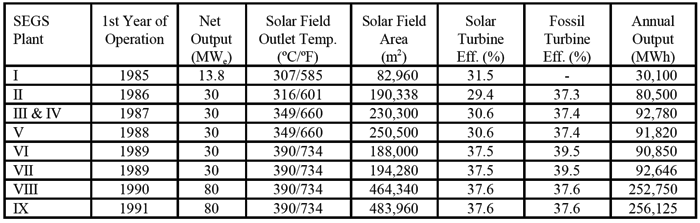
A solar trough power plant with 30 MW turbine was built in 1985 in Dagget, California, followed with solar trough power plants built in Kramer Junction during the late 1980s that powered five more 30 MW turbines. The same design was then used in 1989 and 1990 to build solar trough arrays that powered two 80 MW turbines at Harper Lake. All of those plants operated successfully, requiring only maintenance.
An earlier 14 MW plant built in 1984 in Dagget used a different design. That first plant used oil tanks for heat storage which were destroyed by fire. The subsequent 8 plants did not use heat storage. Solar trough plants being built now use molten salt heat storage (instead of oil storage) to generate electricity at night. Molten salt stores heat safely and efficiently.
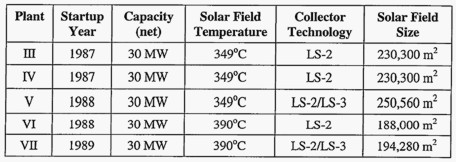
The plants at Kramer Junction were numbered III through VII:
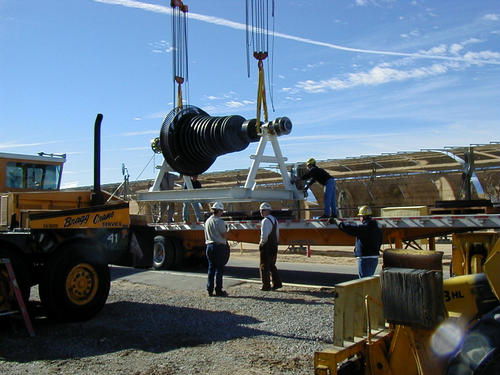
Solar trough plants can use turbines that generate 250 MW to 500 MW
of electricity per turbine,
including the General Electric D Series steam turbine (up to 375 MW)
and the Siemens
Reflectors
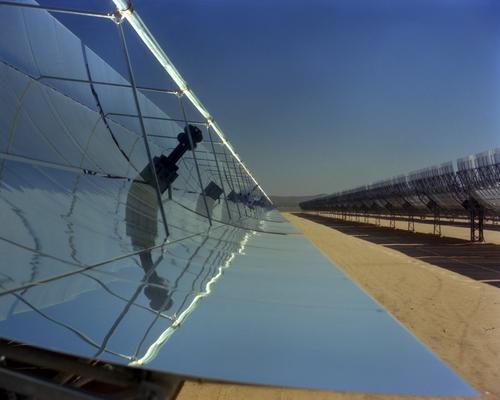
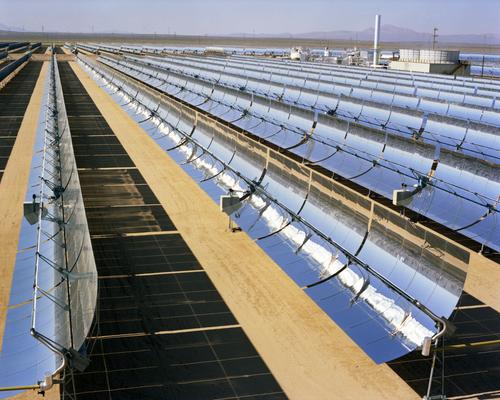
Collectors extended in the North-South direction, along a constant longitude (a longitudinal meridian).
Cleaning
The most effective method of cleaning the collectors was to point them upward when rain or snow was predicted. Snow was reported to do an especially good job. However, the site was sunny 98 percent of each day, so other cleaning methods were required.
Washing was done once per week during peak summer season, using demineralized water. The water was from a well at the site, demineralized on site, creating a small waste disposal problem (to dispose of the minerals that were extracted from the water).
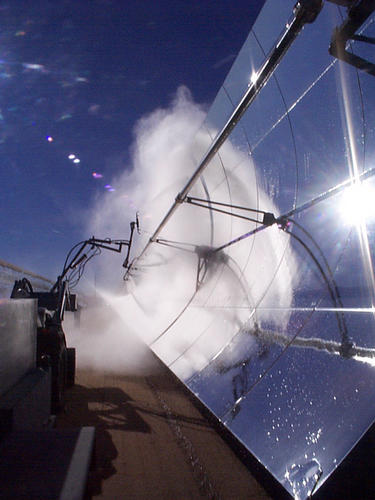
Two washing methods were used: the classic deluge wash, and the twister method which was more effective, but took longer and cost more, so it was not done every cleaning. Both methods used less than one liter (less than one-fourth gallon) of water per square meter of collector area for each washing.
The twister method was almost as good as natural snow cleaning. It used a tractor with twirling nozzles, towing a water tank:
For the deluge method, the collectors faced each other so that two rows of collectors were washed at once. A large tanker truck with fixed sprayers drove between the collectors:
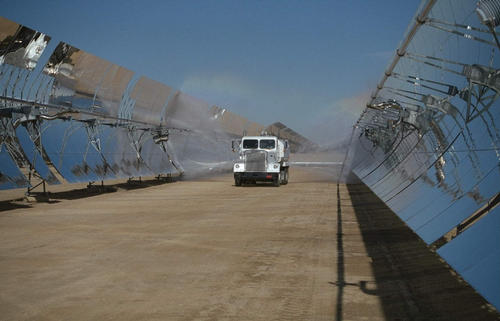
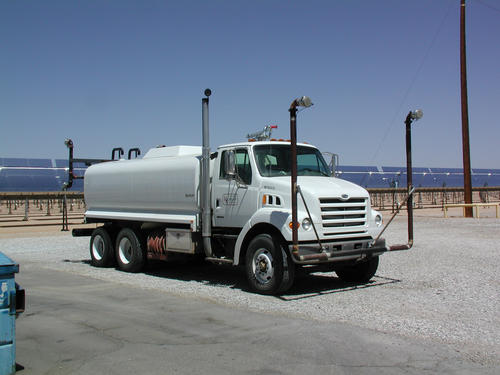
The cost of deluge washing was US $ 0.14 per square meter of collector area per year.
The Kramer Junction PTC system has been dismantled and all materials have been recycled.
Solar Thermal Electricity (STE)
Return to: Architecture, Engineering & Construction