Energy Infrastructure
Solar Thermal Electricity
(STE)
Solar thermal electricity (STE) generates electricity from sunlight using standard steam generators (turbines). It is a type of solar thermal energy.
Solar thermal electricity is generated in deserts and can be transmitted to the rest of the world using high voltage direct current. Large-scale electricity generation with solar thermal collectors can meet all national and global electricity demand.
The leading solar thermal electricity generating
systems, “in order of deployment level”,
are
parabolic trough
and
central receiver tower
systems
(Lovegrove & Stein,
Compared to parabolic trough generating stations, central receiver tower systems (not covered in this article) operate at higher temperatures, sharply reducing lifespan which incurs substantially higher long term cost (to replace the system).
The tower systems may be a temporary bridge to be replaced with trough systems later, unless major improvements in material science are able to reduce the high fatigue rate of materials in the tower systems.
Parabolic trough collector systems are already a proven
mature technology,
putting the technolgy in the category of hydropower.
Some progress to improve the technology is still needed,
but less than for other electricity generation technologies.
For details, see:
Hank Price, Mark Mehos, David Kearney, Robert Cable, Bruce Kelly,
Gregory Kolb, Frederick Morse,
“Concentrating solar power best practices”
In parabolic trough collector (PTC) systems, sunlight in deserts is concentrated in solar trough collectors, to heat pipes that circulate heat transfer fluid to a boiler, producing steam to power a standard electricity generating turbine.
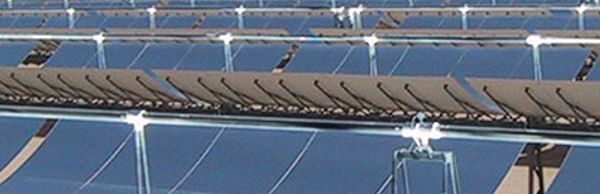
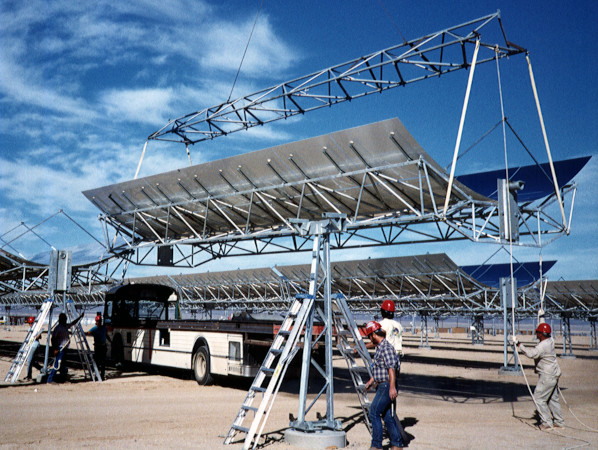
Solar thermal electricity plants are in deserts because much more solar radiation penetrates the dry atmosphere. Heat is efficiently stored in molten salt tanks to generate electricity at night. Deserts retain little heat, radiating heat back to the sky at night. Intercepting a very small fraction of that energy is enough to provide all global electricity needs.
Trough Collectors
American engineer Frank Shuman proposed and built a solar trough collector plant in Egypt in 1913 (Figure 3). Originally planned to generate electricity with a generator (dynamo), a water pump was used instead, to pump water for agricultural irrigation. The plant generated 35 kilowatts (kW) of mechanical energy, with 1233 square meters (m²) of collector aperture area:
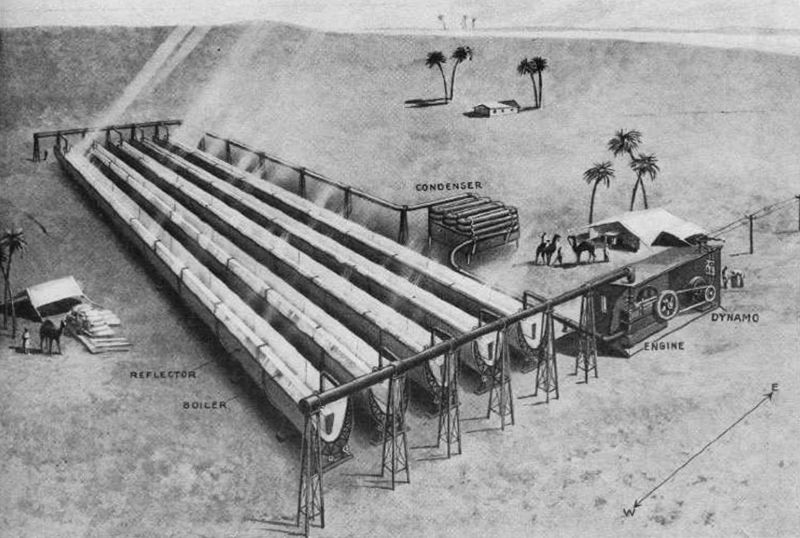
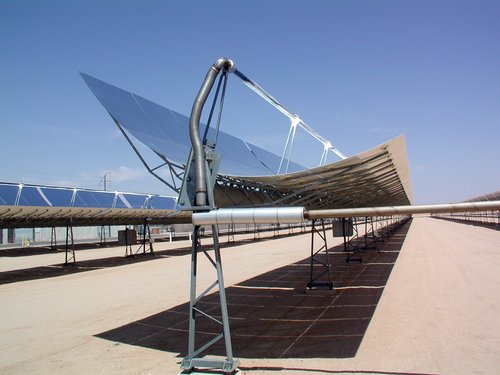
In the Shuman design above, the parabolic reflectors are on rollers and rotate around the receiver fluid pipe axis. Modern trough collectors move the receiver pipe along with the reflectors, on tracking stands with flexible or jointed pipes at the ends of the trough collectors:
Land that is very dry, very hot, and with at least 6.5 kWh/m² per day direct normal irradiance (DNI) is suitable for generating solar trough electricity.
Solar trough technology does not require special materials. Standard metals and mirrors are used (e.g., steel and glass). No special elements need to be mined. Recycled materials can be used.
Adjacent solar trough plants could each power a steam turbine hundreds of Megawatts MW per turbine. Energy storage for peak demand extending into night (time-spread base load) is accomplished with molten salt tank storage (to efficiently generate electricity at night):
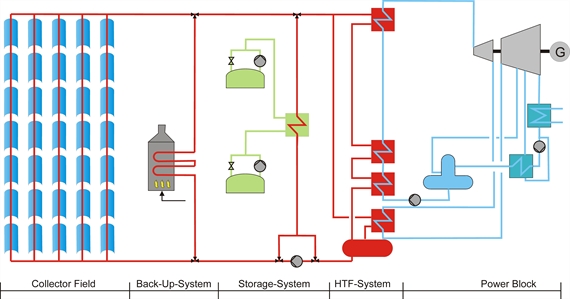
Solar thermal electricity generation works in hotter regions that are not suitable for other uses. The efficiency of these power plants increases sharply with higher temperatures. Such land is ample and far exceeds the land area that is required to meet U.S. and global electricity needs. Research studies or advocacy that do not use the hottest and driest land for STE are not indicative of STE capability.
References for This Page
1. Keith Lovegrove, Wes Stein, Concentrating Solar Power Technology, Woodhead (Elsevier) 2021.
2. Palenzuela, Padilla, Zaragoza, Concentrating Solar Power and Desalination Plants, Springer 2015.
3. Franz Trieb, et al., Concentrating Solar Power for Seawater Desalination, DLR (German Aerospace Center), November 2007. pdf (7.6 MB)
Return to: Architecture, Engineering & Construction