High Voltage Direct Current (HVDC)
Page 8: Overhead Lines (OHL)
Low Impact
Overhead lines (OHL) for HVDC are very low impact,
producing much less radiation than AC lines and
allowing for agriculture and other plants under the lines.
Figure 1:
Steel transmission tower for
a bipolar 2375 km
Rio Maderia
3.1 GW
±600 kV EHVDC line in Brazil.
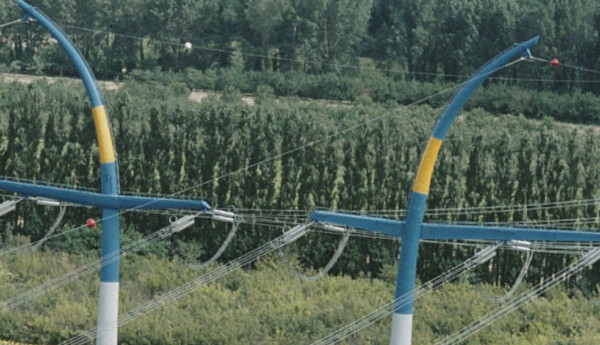
Figure 2:
Transmission towers for the
bipolar 2077 km
Xingu-Estreito
4 GW ±800 kV UHVDC line in Brazil.
Multiple sets of AC towers and much more wire
would have been required to transport this much electricity
with HVAC instead of HVDC.
“there is no field inside the body as if the body is protected by a
‘Faraday Cage’,
possible leakage currents are negligible.
The effect of the
electrostatic induction only occurs by entering
and escaping the static electrical field,
and thus the field is not able to produce permanent body currents.”
—
Nadine May,
“Eco-balance of a Solar Electricity
Transmission from North Africa to Europe”,
Technical University of Braunschweig,
2005,
p. 44–45.
“It is best for the
proposed transmission servitude route to follow the existing road networks and settled
corridors through the five countries…
The land footprint must be kept to an absolute minimum so as to allow for continued
land use such as undisturbed natural ground or commercial farming etc. and
presence of the line has no effect on normal wild life movements.”
—
Thomas J. Hammons, Pathmanathan Naidoo,
“Africa – Integrated gas and electricity transmission
planning in power generation and HVDC engineering
in harnessing large-scale hydroelectric sites
for interconnected regional power systems”,
Energy Systems,
(2010) 1: 79–112,
p. 102.
“the experimental fact that large machines with rubber tires
(such as combine harvesters, automobiles, and some others)
are not electrically charged to levels dangerous for a human
when the machines are standing under HVDC overhead lines
should be considered a significant result of the investigation.
The electrical resistance in the tires of these machines
(at about 10 MOhm) turns out to be enough to prevent the
accumulation of a dangerous charge (via charge leakage)
even when the machine is standing on dry asphalt.
In the case of HVAC overhead lines,
inducted capacitive currents on large machines may be lethal in some cases.”
—
L. A. Koshcheev,
“Environmental Characteristics of HVDC Overhead Transmission Lines”,
Third Workshop on Power Grid Interconnection in Northeast Asia,
Vladivostok, Russia,
St-Petersburg, High Voltage Direct Current Power Transmission Research Institute, 2003,
p. 3.
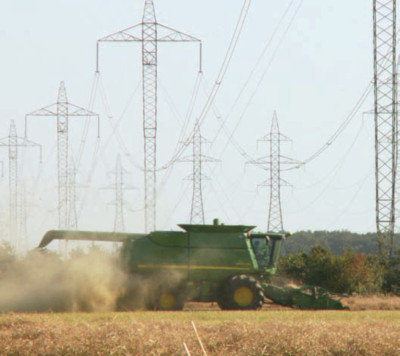
Figure 3:
Agricultural machinery near bipolar HVDC line in Canada.
Three-tier power lines in the distance are AC.
Transmission Towers
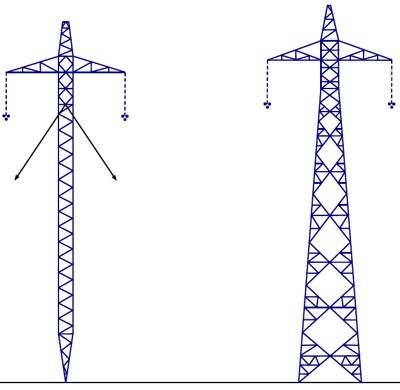
Figure 4:
HVDC transmission towers may be guyed (left)
or self supporting without guy wires (right).
[Manitoba Hydro]
Towers with guy wires are called
tangent towers
and can only be used on sections of transmission lines
that do not change direction (referred to as tangent lines).
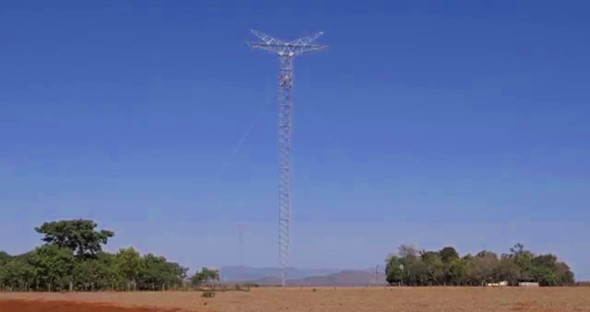
Figure 5:
Bipolar UHVDC tangent tower in Brazil
(Xingu-Estreito
4 GW ±800 kV).
Figure 6:
Top of a bipolar tangent tower for an
Itaipu 800 km 3.1 GW ±600 kV
EHVDC line in Brazil.
Shield (ground) wires at the top of both sides of
the tower are for lightning protection.
Figure 7:
Tower at converter station
for a bipolar Itaipu
3.1 GW
±600 kV
EHVDC line in Brazil.
DC switch yard is behind the tower.
New Designs
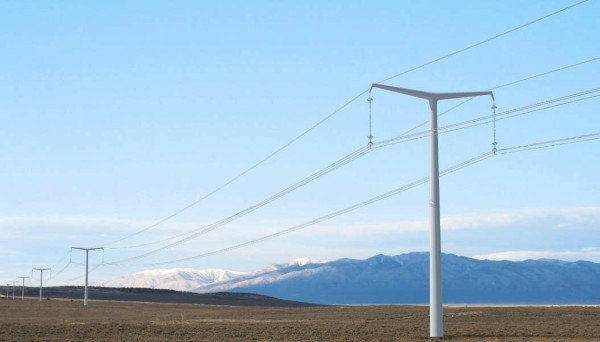
It is possible to design transmission towers with
more aesthetics. For example,
poteaux roseau
HVAC transmission towers
could provide ideas for
designing UHVDC towers.
Figure 8:
Poteaux roseau HVAC tower in France.
[
JNourtier]
Figure 9:
Poteaux roseau construction.
[
Mimram]
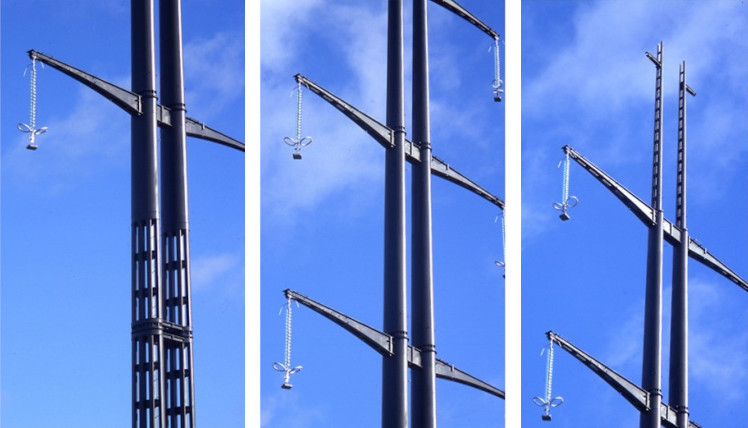
Figure 10:
Poteaux roseau erected.
[Mimram]
Poteaux roseau structure is twin-tube,
with multiple tubing
forming overall vertical tubes
in the lower segments
(left photo),
like reed bundles (“roseau”).
Structurally, this is like
saguaro cactus skeletons:
Figure 11:
Saguaro cactus skeleton.
Live saguaros in left background.
[
Postdlf]
Figure 12:
Twin saguaro skeletons.
[
Levine]
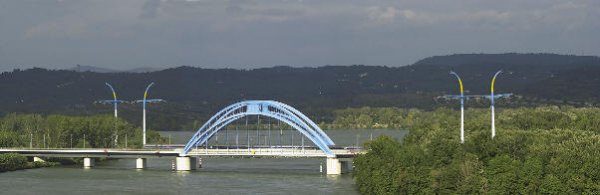
Transmission towers may be single tube posts:
Figure 13:
Tubular HVAC transmission towers (behind bridge).
[JNourtier]
Figure 14:
Tubular HVAC transmission towers,
curving to
hold shield (ground) wires above AC conductors
for lightning protection.
[
RTE]
For standard bipole HVDC
(±500 kV),
compaction of towers
may be possible, by placing
towers closer together to reduce line sag, and
reducing metal sructure between
the positive and negative poles (conductors).
Positioning conductor bundles
closer together on each tower
reduces right-of-way (ROW)
land requirements.
Figure 15:
Possible bipole HVDC tower design,
with shield (ground) wire above each pole insulator.
[Bystrup Arkitekter]
References
High Voltage Direct Current (HVDC)
Return to:
Architecture, Engineering & Construction
NewUnivStudies.org