Environmental Design
Energy Efficiency
Solar Reflectance and Material Emissivity
Color Temperature
Color temperature is a convenient shorthand way of describing the color rendition capabilities of visible light that has blackbody temperature profiles, such as sunlight, candlelight, filament lamps, etc.
Blackbody Radiation
All objects that are hotter than
absolute zero
The emissivity of an object is the ratio of how much heat the object can emit as radiation, as explained in Solar Reflectance and Material Emissivity.
Objects store heat as molecular vibrations. The molecules of objects stop vibrating at absolute zero. At temperatures greater than absolute zero, molecules vibrate and emit electromagnetic radiation.
A blackbody is an object, made of any material, with any shape, that has full (100%) emissivity. It has been discovered theoretically that such objects have a particular profile of how much of each wavelength of light will be contained in their electromagnetic (EM) radiation.
Such an object, called a blackbody, does not quite exist, but objects that come close to having perfect emissivity do actually emit radiation as if a blackbody.
The blackbody radiation of an object only depends on the temperature of the object (and on the object having full emissivity).
All objects with very high emissivity, at a given temperature, will convert heat to radiation emission of a predictable output per wavelength at that temperature, as if a blackbody, according to Planck’s Law.
The peak wavelength of the radiation can be calculated with Wien’s Displacement Law:
λpeak = (∼2897.772) / T
where λ is the wavelength in micrometers (µm) and T is the temperature in kelvins.
One kelvin equals 1° on the Celsius (Centigrade) scale.
The only difference between Kelvin and Celsius is that
Kelvin has its zero point at absolute zero
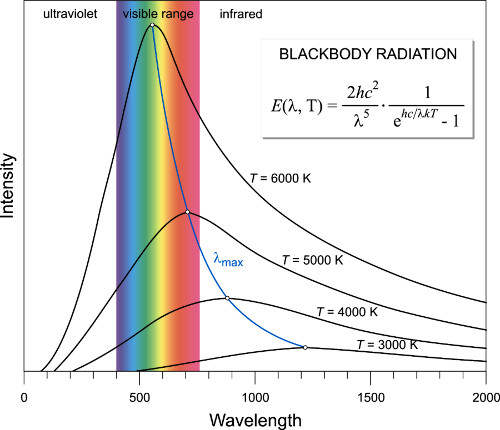
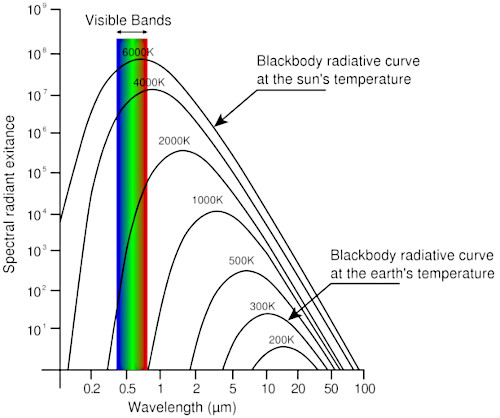
The color temperature of a light source describes its profile of wavelengths in the visible light spectrum. Emissions in nonvisible wavelengths are not accounted for in color temperature.
A light source with color temperature greater than sunlight will have more blue and violet wavelengths.
A light source with color temperature lower than sunlight will have more yellow and red wavelengths.
The human circadian rythm expects longer wavelengths of light at night, and shorter wavelengths during the day when the Sun emits huge amounts of blue light that we cannot “see” but which are nevertheless sensed by cells in our eyes.
Thus, light sources with longer wavelengths (lower color temperature) are better at night.